Sunday, January 8, 2017

First, let's talk about the cars

When we told people that we were going to Cuba, the first thing that most people were interested in was the old cars, so here we go. The following is in no particular chronological or logical order, as is fitting for our entire Cuban experience.  Cuban cars come from three basic generations:

1) American cars left over from the Victory of the Revolution at the end of the 50's. These include a lot of late 1940's and early 50's cars along with the more famous mid-50's American cars. 

2) Russian cars from up until the collapse of the Soviet Union around 1990. The most common single car in Cuba is the Lada 1600, which is a Soviet version of the Fiat 124. If you are trying to get economical taxi cabs on the street in Havana, this is the most likely thing you will be riding in. Here is what they looked like when they were new:


3) While Cuba is generally unable to import cars for economic and political reasons, there is still an influx of cars due to rental car agencies, embassies, multinational companies and, apparently, sailors who are able to import cars after serving the fleet for some number of years. I got this information from a taxi driver whose Spanish I could mostly understand. 

Our first taxi was from the airport and it was a generic modern-ish thrashed car, probably from the around 2000. There are several of these in the larger tourist cities, and they generally serve the airports. They have functional A/C and have no historic or aesthetic value. 

Here is our second taxi. This is what Cuba is famous for: late 40's and early-to-mid 50's American cars. You will only find these in Havana and in the other big tourist area, Varadero. By now, the majority have had their engines replaced several times over and are Franken-cars. Toyota brakes, Lada engines, whatever parts can be scrounged. This one had A/C which was taken from a mini-van and you can see the unit behind the driver's head. The suspension on all of these cars died an agonizing death some time in the 90's. They are cool looking, fun to be in, and suited for speeds under 40 mph on smooth roads. Perfect for Havana. 


You can find rows of these classics in various places around Havana. With some bargaining, a drive across town costs about $6. If the cruise ship is in port, the price will be higher. 

Here is the other side of the Cuban taxi experience. A generic steering wheel attached to a late 40's American car with the mechanic riding shotgun. When was the last time you rode in a car with a 2-piece flat glass windshield? Most of these cars have no suspension of any kind, and are little more than a shell surrounding just enough machinery to move forward. Seat belts? What are those? 


Here is Sherry posing with a first-generation Corvair. We saw a few of these rolling around.


 Another classic American 50's car in Havana

 This is what you are more likely to see - an early 50's car without much historic value, pained a flat color. These function as "collecivo" taxis - they run the same basic route and pick up anyone who flags them down. You just pack in with whoever is already in the cab. We never really figured this system out, and ended up just getting a cab for the two of us. These old cars will also just take two people to their destination if the price is right (generally $5).


 More classics hanging out in front of a large tourist hotel.


 Another older 2-window car that we took. Original steering wheel this time.


What is missing from the tour books that we read, and the nostalgic image of Cuban cars is the fact that these are really old cars and they pollute at impressive rates. Between the old busses, the ancient cars, and the complete lack of any kind of emissions controls, the streets of Havana are just filled with smoke, burning oil and clouds of diesel. London in the 90's has nothing on Havana. According to one of our hosts, Cuba imports wrecked European cars, especially diesels, and parts them out in order to keep the old cars going. Quite a few of these cars are running on old Peugeot or Mercedes diesel engines with huge numbers of miles on them. Remember those old diesels in the 80's that spewed black clouds? Now run them for another 25 years and you can start to imagine the situation. Thankfully, Havan is right on the ocean, and the breeze blows the smoke away overnight and, by morning, the air is clear again.


Saturday, January 7, 2017

Getting from DC to Havana

There are rules about going to Cuba. According to the State Department:

Travel to Cuba for tourist activities remains prohibited by statute. However, the Department of Treasury’s Office of Foreign Assets Control (OFAC) has issued general licenses for 12 categories of travel.  

The reality is that nobody checks. Our most rigorous interrogation came from the confused check-in clerks at Dulles who had clearly never processed anyone going to Cuba before. They were looking up the rules and asking us questions until one of the supervisors came over and just said to just let us check in. At the gate in Newark, we had to pay $75 each for our tourist visa and then check one of the 12 boxes indicating our reason for traveling. End of questioning. Upon returning home, there was no question of any kind regarding the purpose of our visit. The take-away is that, at least for now, you can just go. Check the "people to people" box for your reason and get on the plane.


We had signed up for 2 weeks of Spanish Language classes, one week in Havana and one week in Trinidad. Because we flew down on Thursday, and classes started Monday, we had three days to settle in and yet another day after classes were over before we left for Trinidad, so 9 days in all. More on that later.

If you have ever been to a Caribbean island, you will feel a certain familiarity when landing in Cuba. The heat and humidity, the chaotic airport scene, 100 taxi drivers trying to take you to your location. The whole works. It took a really long time to get through immigration because they have to take your picture and check your visa and stamp the passport. I think that the picture has to travel via serial port to the mid-1990's 286-powered computer for processing, based on how long it took for them to move from one person to the next. If you have booked a package tour, then you will just meet with your tour coordinator and get on the modern air conditioned bus that will whisk you to your hotel. If not, get ready to stand in line at the one and only money exchange window at the airport to get some local currency because your ATM card and credit card won't work here, and then haggle for a taxi. Actually, not much haggling at the Havana airport. It is a flat standard fee of 30 CUC ($30) to get to anywhere in Havana.

Now, sit back and relax and watch the next half hour slip by looking at the old cars, the concrete architecture, and the oddly abundant motorcycles with sidecars. The plants and geography are  the same as you will find in nearby Puerto Rico, Jamaica, the Yucatan Peninsula or the Bahamas. Limestone and a low scrubby jungle.


Getting to a particular address generally involves at least two stops to ask directions. The address system is incomprehensible to westerners, and generally you are given a street name and the two cross streets. Taxi drivers tend to just stop and ask locals where the place is located.  We chose to stay in the "Vedado" neighborhood in Havana. It is a bit of a haul from there to old Havana, but it is quiet and not as loaded with tourists. It was about a 20 minute walk to our classes in the morning, so we would get in a quick bit of exercise before sitting down for a few hours.

We stayed at an Airbnb (link to the apartment) and it was lovely. I think that it was around $40 per night We got lucky and had the big bedroom that connects directly to the porch for all of the nights but one. Here is from inside of the living room, looking out.


This is the porch where we wait anxiously for our coffee


Another view of the porch. Apparently, we did not take a picture of the bedroom, but it was nothing special. As we came to realize, none of the bedrooms anywhere in Cuba have furniture unless it was built-in during construction. Often times the bedframes had been nailed together out of old shipping crates and, generally, the individual mattress coils could be discerned. Everything was very clean and comfortable enough, but the lifestyle is a bit monastic. Thankfully, all of the rooms had some kind of window unit air conditioning to help our mid-Atlantic bodies slowly adjust to the humidity of a DC summer again, and to drown out the dogs, horns and roosters. If this type of travel doesn't suit your taste, there is always the option to stay at one of the tourist hotels in Havana or Varadero. They cost between $250 and $400 per night and have, I assume, all of the comforts of home. I can't deny that there were a night or two where that option seemed really appealing.


Breakfast is served for an additional $5 each per morning. Seemed like a good deal to us. The other reason that it was a good deal, is that there really aren't any breakfast restaurants or diners in Cuba. No coffee shops. The little pastry shop below our apartment did not open until 9am, so we would have missed classes in order to eat a few sugary snacks. I don't think that I have ever consistently eaten this much fruit in my life. Every breakfast came with a big plate of fruit and a pitcher of just-now-blended fruit juice. The little bottle in the bottom right corner has space left for rum to make our 5pm cocktails.


So, about 8 hours after leaving DC, we were unpacked, settled in, and out looking for dinner. Stay tuned. 

Thursday, July 28, 2016

More photos of the bike trip from Pat's camera.


Relaxing on the beach in Oregon near our first campsite.

Chickens at the Airbnb in Eugene, Oregon. We got fresh eggs every morning.


Coming out of Sisters Oregon.

More views from Sisters, Oregon. At least two of these mountains are sisters. I think that the third sister is hiding.


While we still had the car, Sherry drove us to the Painted Hills in Oregon.


Prineville? Dayville? Prairie City?


Fresh water by the side of the road near the completely empty Bates State Park. A bartender told us about this spring. It was near the exit that she used to meet her ex-husband to exchange their daughter.


 Waiting for Tom to arrive in Baker City, Oregon - we went to the movies to see X-Men Apocalypse. One seriously stinky turd of a movie, but there aren't many movie choices in small towns. Either the latest Disney kid movie, or the latest action movie.


Tom's 26 year old Novara touring bike, all loaded up.

Somewhere in Eastern Oregon.


 Yes, his thermometer says 108 degrees.


A hammock is a lovely accessory for bike camping.


Ever little town has a post office. Some of them are little more than a construction trailer with an American flag outside. Tom mailed home a lot of his unnecessary gear from Lucile.


The Swiftwater RV park near White Bird, Idaho. Nice neighbors, a shower, cold water, and a lovely river to camp next to.


At the top of the White Bird pass. Lots of elevation gain, but a relatively low grade, so we just pedaled and slowly made it up.


Temporary flatness heading out of Grangeville, until we hit our steepest downhill of the trip. Probably 2 miles of 16%. We each hit over 40 mph and could smell our brake pads.


Our lovely hotel-mates in Kooskia, Idaho. The passenger flashed her Glock as she was unpacking, just so we would know.


Sign says "Winding Road Next 99 Miles" and they meant it. We are on Rte 12 in Idaho following the Clearwater River and the Lochsa River for the next 99 miles. There were no services at all along this stretch. Not a single gas station, hotel or convenience store.

Pat, entering Montana. We had just gone over Lolo pass.


Missoula is the headquarters for the Adventure Bicycling Association, and any rider who comes through can get a polaroid pinned to the wall. This is Pat's.


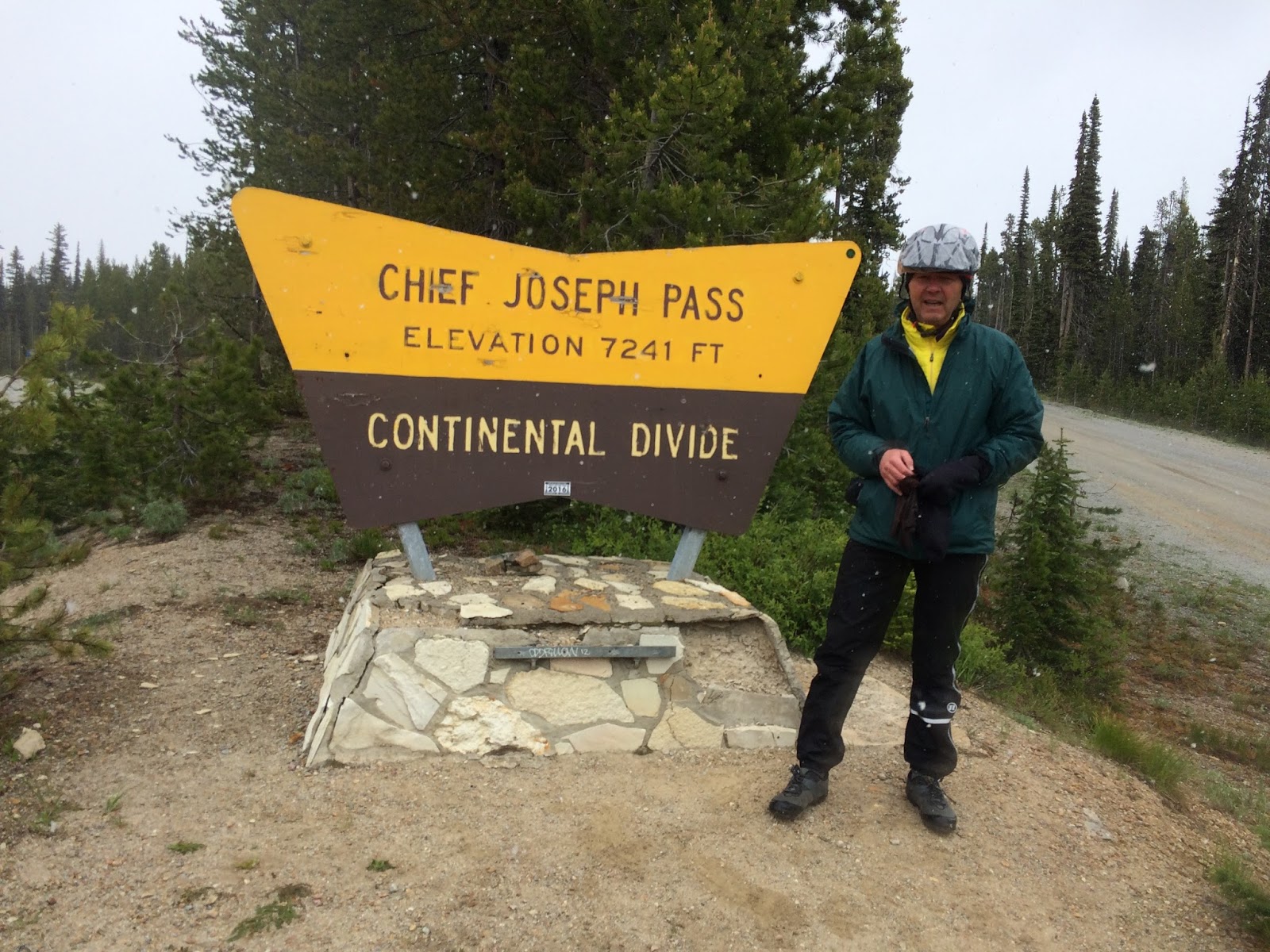
Pat, wearing every piece of clothing he has and getting ready for the downhill. It snowed on us coming over this pass and the downhill was really cold.

More mountains and barbed wire.


Mooo - Wyoming is cattle country


At Quake Lake, this entire hillside slid down into a river and created a large lake behind it, and killed quite a few people in the process. Parts of the hillside ran all the way up the other side of the valley.


Coming into Yellowstone at the West Yellowstone entrance.


Cooking something in Grant Village, Yellowstone


Taking a break from the RV's and the Harleys in Yellowstone.


The local meat shop in Dubois provided the Italian sausage for our pasta sauce, cooked in the church kitchen.


Lots of antlers around here.  We took a rest day in Dubois and just wandered around the town.


The church in Dubois where we spent one night.


A dramatic shot of the run-down church in Jeffry City


Melt some butter, brown the pecans in the butter, add some bourbon and stand back to let them flame, pour in some real maple syrup and wait for it to come to a boil and then add the thinly sliced banana. Let it cool a little while the french toast is cooking. Serve, eat, be happy.


Lots of cracks in the Wyoming roads, many of them leading in the direction of travel. They were pretty wide and seemed to be filled with black marshmallow goop. Best not to get your wheels in them.

The Beaver Creek fires in the distance, coming into Riverside, Wyoming


Chili a-la-Pat in Riversideside, Wyoming.


Enjoying the chili.


Another view of the Beaver Creek fires, still burning mostly uncontained. On the road from Riverside to Walden


The pie shop in Granby, Colorado - we ate half for dessert and half for breakfast. It was a drive-up shop but we just walked.

Wednesday, July 20, 2016

Article for the Neighborhood Newsletter About the Bike Trip.

This is an article we wrote for our neighborhood newsletter about our 6-week bike trip from Astoria to Boulder. Plenty of photos here:  https://goo.gl/photos/knBhHC23uTsVmFhR7

Who: Pat White of 3315 Elm Terrace and Mike Evanoff of 3319 Elm Terrace
What: 6-week bicycle tour from Astoria, Oregon to Boulder, Colorado with a total of 2270 miles of riding.
When: 23 May through 4 July


40 years ago, in 1976, a group called “Bike-centennial” rode bikes across the USA to help celebrate the Bi-centennial. We both remember that adventure and have wanted to ride the route ever since. Bike-centennial is now the “Adventure Cycling Association” but the route has remained and has been refined over the years. If you Google “transamerica bicycle trail”, the first hit will be the route we rode. The route is over 4000 miles, and generally takes about 10-12 weeks to ride. Since we could only take six weeks off to do the ride, and we did not want to try to rush across the country, we decided on riding only the western half this year. We wanted to visit the sites, talk to the locals, soak in the hot springs and generally go at a pace that would allow us to drink in the experience. The eastern part of the route will have to wait for another year.


We are both long-time bicycle commuters, riding back and forth to work to avoid traffic and to stay in shape. However, Pat had never been bicycle touring and Mike’s experience was limited to a few trips in college and a 10-day trip last summer. Pat had not slept in a tent for more than 20 years. Clearly, this was a big and uncertain undertaking for two novice bike tourists.
Mike and Sherry went first to Washington State to visit Mike’s parents and then picked up Pat in Portland to start the ride in Astoria, Oregon. We had already shipped our bikes to a local bike shop in Astoria, so our first order of business was to pick them up and put them together. Once we started riding, Sherry shadowed us in the rental car for about 7 days, which made for a nice easy first week because we just threw the bags into the car and could ride unloaded. Sherry would get to the campsites and have cold beer ready for us on arrival. When Sherry left us near John Day, Oregon, we were all alone for the first time. Kicked out of the nest and having to fend for ourselves.


Everything we needed was on the bikes. We each carried a tent, sleeping bag and sleeping pad and we shared the group gear which was mostly cooking equipment. We camped most nights, but stayed in roadside hotels or cabins when the mood hit, or when there was no good camping option. Several towns would allow people to camp in the city park for free, and several churches allowed bike riders to sleep in their basement or social halls. Otherwise, commercial campgrounds and RV parks generally had some form of tent camping option. The beautiful thing about bike touring is that you pass grocery stores and liquor stores on a daily basis. No freeze-dried camp food or instant oatmeal for us. We had eggs and grits or french toast for breakfast, and our dinners ranged from stir fry to pasta sauces with locally grown sausage to big fat chunks of salmon. We were the travelling gourmets. It is amazing what you can do with a propane burner and an Ace Hardware frying pan. A lot of the small towns in the west have a local meat shop because there are so many cows and ranches. We had really nice grass fed beef, some lovely pork loin and the best beef jerky that either of us had ever had. Many hours on the bike were spent daydreaming about what we would cook for dinner that night.


The bikes held up really well - we each had one flat tire and that's about it. We oiled our chains and kept the tires mostly pumped up and suffered no mechanical issues of any significance. Other than Mike pitching his tent on top of a very powerful sprinkler head, and realizing his mistake when the sprinkler came on at midnight, we didn’t have any real disasters in camp, either. Since we were on the most popular bike touring route in the country, there were usually other cyclists in the campground with us. We had a small brotherhood of lunatics wherever we went! While most bike tourists seem to be men between 55 and 65, there were a number of younger people, several couples, lots of Dutch people and one young couple who were too beautiful to be roughing it, yet here they were. Bicycle touring is physically demanding, but if you go slow, and just keep moving, even marginally  fit people seem to be able to complete the distance. We rode about 60 miles per day and then took a few rest days inbetween riding days, and every day was a challenge in some way.  In the end, between the uphills and the headwinds, we each lost about 10 pounds.


A typical day started with one of us getting out of the tent and making fresh drip coffee - Pat’s black and Mike’s with half-and-half, often a collection of little containers liberated from a diner. Next we made breakfast while packing tents and sleeping bags, or we just went to a diner if we thought there would be one within the first 20 miles down the road. Most days we would also incorporate a breakfast beer at the top of the first climb, or just some time before the beer started to get warm. Mike, the organized one, would leave camp a little before Pat, but would get caught pretty quickly. We would typically stop at each small town we passed if nothing more than to fill up water bottles or buy a snack. Lunch would last from 9am until 3pm and consisted mostly finger food in the handlebar bag. We were both partial to Fig Newtons, Mounds bars, bananas, and PB&J sandwiches. We were riding about 60 miles per day, and had an average pace of about 12 mph, so each day saw about 5 hours of turning pedals. Sounds like a lot, but we broke it up with rests, small towns and the occasional swim break. During the day, we each spent some time daydreaming about what to have for dinner, and we planned the day’s ride around where to shop for food. We had a lunchbox style cooler that would fit a six-pack, some ice, and a few other cold items, and we packed the rest of the food into whatever space we had in our bags. Finally, we would roll into our destination town and find the park or the RV site or a church or a hotel and settle in for the night. We stayed in hotels or cabins a little more than we had first anticipated because Mike was sick for about two weeks from Missoula until late into Wyoming and a good night’s sleep helps considerably.  We had record high temperatures in eastern Oregon and Idaho, we had unseasonably cold weather in parts of Montana (we got snowed on going over one of the passes) and the winds in Wyoming are not to be underestimated. The only thing we mostly avoided was rain. There really was no typical day, because each day had a challenge built into it somewhere.


Since we are both social and inquisitive, we interacted quite a bit with the locals in the towns along the route. We were both surprised at the entirely different way that “Westerners” view the country relative to our eastern views. Since our trip was more of a journey than a destination, we went to the museums, read the roadside history signs, and generally took our time. Mike was constantly chatting up people we met in restaurants, on sidewalks and by the side of the road.  In Baker City, OR, after talking to a couple with a beautiful tandem bicycle, telling them about our tour and geeking out over their cycling equipment, Mike was told about a couple in Halfway, Oregon named Whitey and Katie who might put us up for the night. Whitey said to come ahead (“look for the green dormers, that’ll be us”) and suggested they’d feed us as well.  


Whitey and Katie welcomed us, told us to put our bikes in the barn, and then showed us to our private bunkhouse rooms.  They explained that they had built the bunkhouse for their visiting sons and daughter and grandkids.  After we’d showered and had a couple of beers, we got better acquainted on the front porch and they began to make an amazing spread, including homemade hamburger buns (!) and a chocolate peanutbutter dessert.  


After dinner, Whitey and their dog walked us around their property and we met llamas, who have the personalities of lawn furniture, but with amazing deep dark brown softball-sized eyes.  He told us about taking pictures of the wildlife that is all around them, but seldom seen, except with his motion-detector camera, and was quite proud of the mountain lion he had photographed.  Walking through what had been an orchard, we saw at the edge of their property a big animal with its head thrust up into an apple tree.  At first we thought it was a deer, and as we startled it and it bounded into the woods, realized it was an elk, probably female.  


As a kid I remember reading about how hobos network and even leave symbols at individual houses where the family was welcoming (or not) and willing to give food or share food in exchange for work.  The cycle touring network functions in much the same way, and during our eastward ride we were constantly talking with westbound cyclists and exchanging intel about church basements, campgrounds and the availability of groceries (and beer) at our next waypoint.  So we learned that the Baptist Church in Jeffrey City would let cyclists overnight in the basement, that there was no water or retail or anything in Lamont, and that Lander had a great city park that allowed overnight camping.  We also fell into shifting cohorts of riders on our eastbound route.  “Ohio Mike” was a grizzled retired mechanical engineer who grew up on a farm in Iowa, was going to ride to Muddy Gap and then head for Iowa’s famous Ragbrai Ride to meet up with this daughter, loved to poke fun at Pat for having boiled our only pot dry on the camp stove and destroying it, and explained that his wife let him tour on his bicycle so that he wouldn’t get tattoos.  Ron and Marion.  Marcia and Husband.  Tom and Katie.  Bart and Ian.  John and his third attempt.  


I think that we were both surprised at what environmental disasters had been inflicted on the west. Most of Montana is treeless because of clearcutting around 1900 and then the overgrazing by cattle and sheep. Many of the towns, including Missoula, had mining operations that dumped all manner of toxins and heavy metals into the rivers, and the cleanup did not even begin until the 1960’s. Gold mining has left many stream beds completely ruined with endless mounds of tailings. There was a period where timber and mineral extraction was carried out on large scales without any concern for the environment or sustainability. I think that the east had similar treatment, but more years have passed to allow the land to heal. In the west, it is still quite apparent and the scars are fresh. Many of the small towns that we passed through had been timber or mining towns, but now the population is in the hundreds (or dozens), not the thousands that used to be there. These towns are dying or barely clinging to life with no apparent economic miracle on the horizon.

For a couple of middle-aged east-coast city boys, this trip was enlightening, difficult, awe inspiring, completely outside of our comfort zones, thrilling, crushing and, in the end, a real journey. We each have a different appreciation for the people and the landscapes that we passed through, and for our own abilities to travel through them.